Painting the Bow Valley: Why I Keep Returning to the Three Sisters
There are mountains you paint once, and there are mountains that keep calling you back. For me, the Three Sisters above Canmore are the second kind. I've painted these three peaks more times than I can count, and every time the Bow Valley shows me something I'd missed before — a different light, a shift in the season, a colour in the rock I'd never noticed.
Most mornings here the light comes up cold and blue over the valley, then warms as it climbs, and by the time it reaches the summits the stone has turned almost gold. That short window is what I chase in the studio. I'm not trying to make a photograph of the mountains. I'm trying to hold onto the feeling of standing at the foot of them, small and awake, with the whole valley opening out in front of you.
People sometimes ask why my Rockies paintings lean toward bold shape and colour rather than fine detail. The honest answer is that the mountains themselves are graphic. Seen from the valley floor, the Three Sisters read as strong, simple forms — ridgelines stacked against the sky. I spent twenty years as an architectural illustrator before I painted full time, and that eye for structure never left me. When I paint the Sisters I work in latex-acrylic, blocking in the big shapes first with wide, straight brushes, then cutting the edges with an angled one. The paint is heavy enough to hold every stroke, so up close you can still read the direction of the brush in the rock faces. That, more than careful blending, is what gets me to the truth of the place.
The Bow Valley is more than a backdrop for me. It's home to Canmore and Banff, to glacial lakes like Moraine, to wildlife moving through the trees, and to a light that changes by the hour. Each of those subjects has found its way onto a canvas. Some of them — like Three Sisters, Canmore, finished under a deep resin coat — are still here in the studio waiting for the right wall; others sold to collectors who stood in this valley once and wanted to take the feeling home. If a view of your own is calling you, that's exactly what a commission is for.
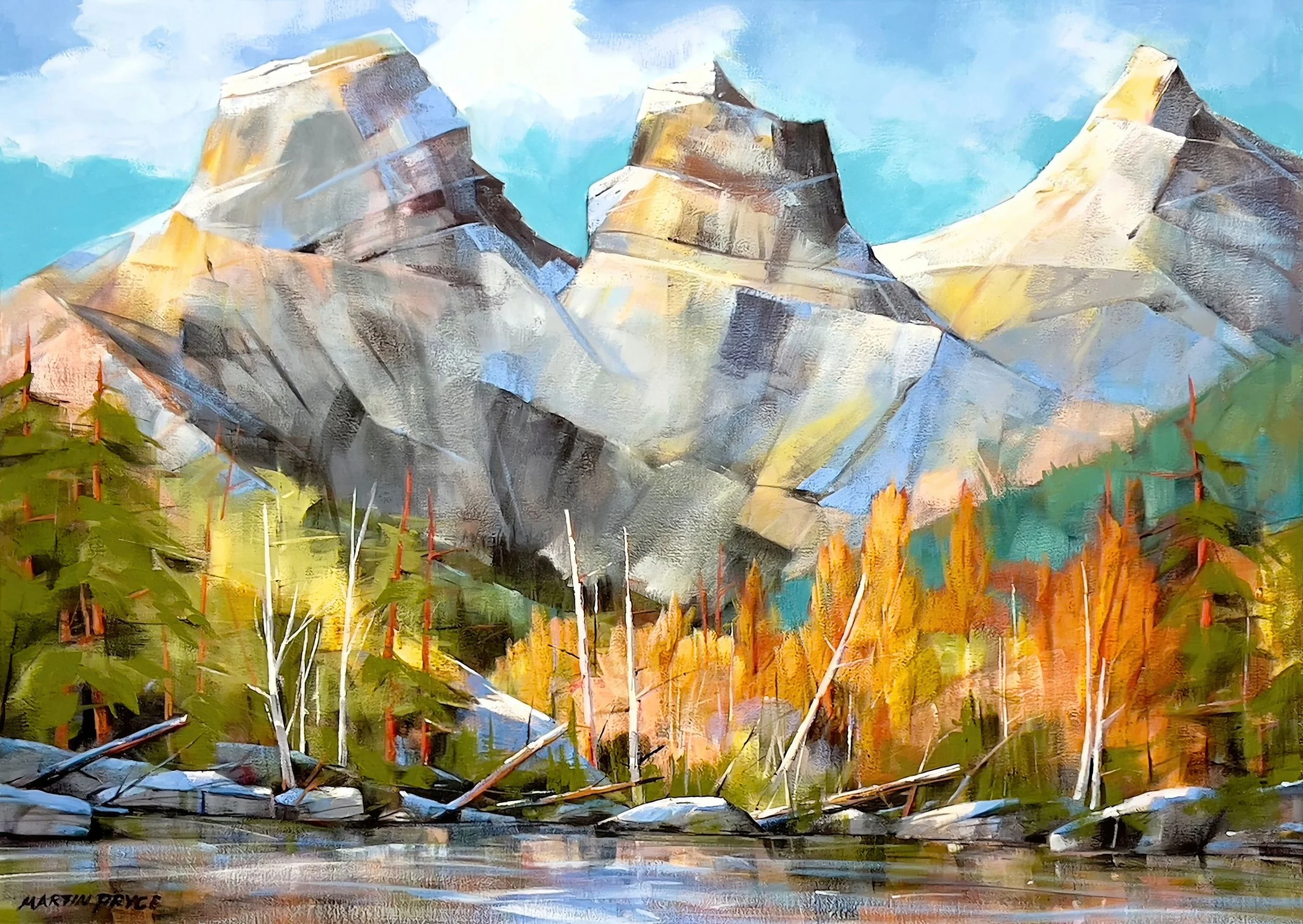
If you've stood in this valley yourself, I hope these paintings carry a little of it home with you. And if you haven't been yet — come in the early morning, look up at the Three Sisters, and you'll understand exactly why I keep painting them.
I'll keep sharing these stories here in the Journal, one painting at a time. Thanks for following along. — Martin